
Engineering the E-Learning Brain
Evidence-based strategies to maximize learner performance, retention, and ROI.
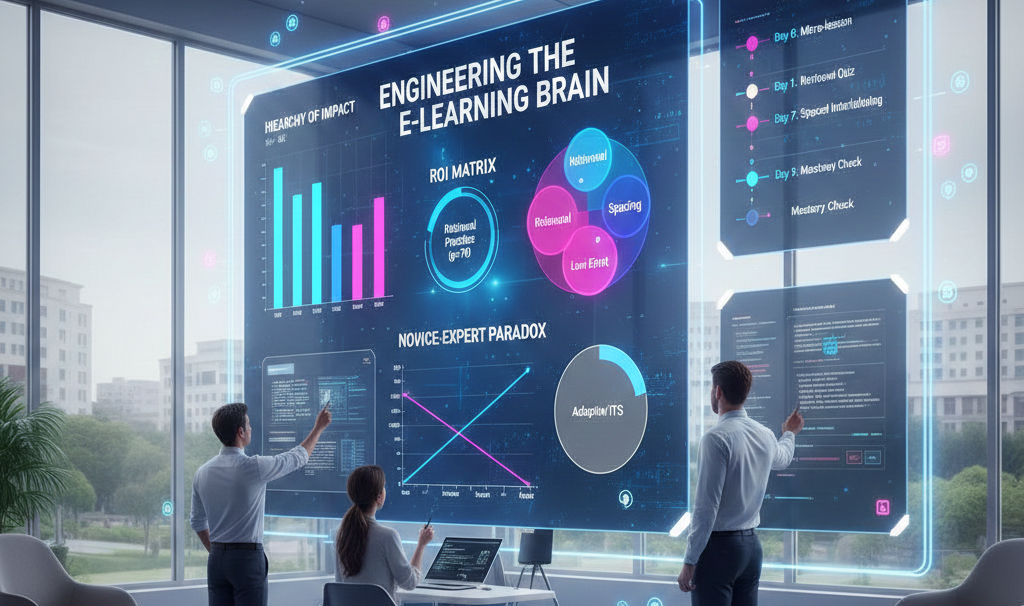
Not all teaching methods are created equal. Decades of cognitive science research have revealed a hierarchy of instructional techniques. Some, like Retrieval Practice, offer massive returns on investment. Others, while popular, require massive effort for smaller gains. This guide visualizes the data behind high-performance course design.
Retrieval Effect (g)
Comparison meta-analysis impact vs. restudy.
Contiguity Effect (d)
Impact of aligning text & visuals spatially/temporally.
Variance Explained
By “Deliberate Practice” alone (without design support).
The Hierarchy of Impact
Which techniques yield the highest standardized effect sizes across meta-analyses? Multimedia Principles (clean layout) and Retrieval Practice (quizzing) outperform complex interventions like Adaptive Learning (ITS) in raw output per unit of complexity.
Values represent typical Hedges’ g or Cohen’s d from meta-analyses.
The E-Learning ROI Matrix
Balancing Effect Size (Y-Axis) against Implementation Effort (X-Axis). The sweet spot is the top-left quadrant: High Impact, Low Effort. Retrieval Practice and Spacing rule this zone. Adaptive Learning yields results but requires heavy technical lifting.
The Novice-Expert Paradox
Strategies are not universal. The Expertise Reversal Effect shows that while novices thrive on high guidance (e.g., Worked Examples), experts are actually hindered by it, preferring unguided problem solving.
The Optimal Retrieval Schedule
To maximize retention ($d \approx 0.78$), learning events must be spaced. Here is a proven “Retrieval Cycle” structure.
Day 0: Initial Exposure
Short micro-lesson + Worked Example. Focus on reducing cognitive load.
Day 1: The First Retrieval
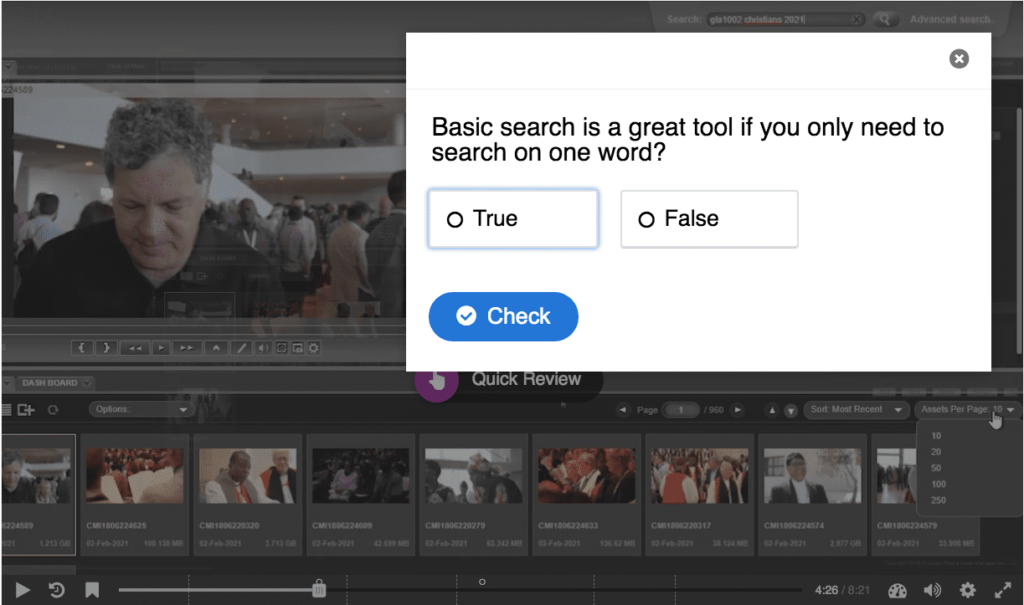
Low-stakes quiz (no grading). Immediate Elaborated Feedback is crucial here.
Day 7: Spaced Interleaving
Revisit the topic mixed with new topics (Interleaving). Forces brain to discriminate between concepts.
Day 30: Mastery Check
Final retention check. If passed, move to maintenance. If failed, trigger remediation loop.
Implementation Checklist
-
❶Reduce Noise First.
Before adding quizzes, clean the UI. Align text with visuals (Contiguity) to save working memory.
-
❷Test to Teach, Not to Grade.
Replace 30% of reading time with active retrieval. Keep stakes low to reduce anxiety.
-
❸Automate Spacing.
Use email or LMS triggers to surface content 1 week and 1 month after completion.
-
❹Fade Support.
Start with worked examples for novices, then transition to independent problem solving as expertise grows.